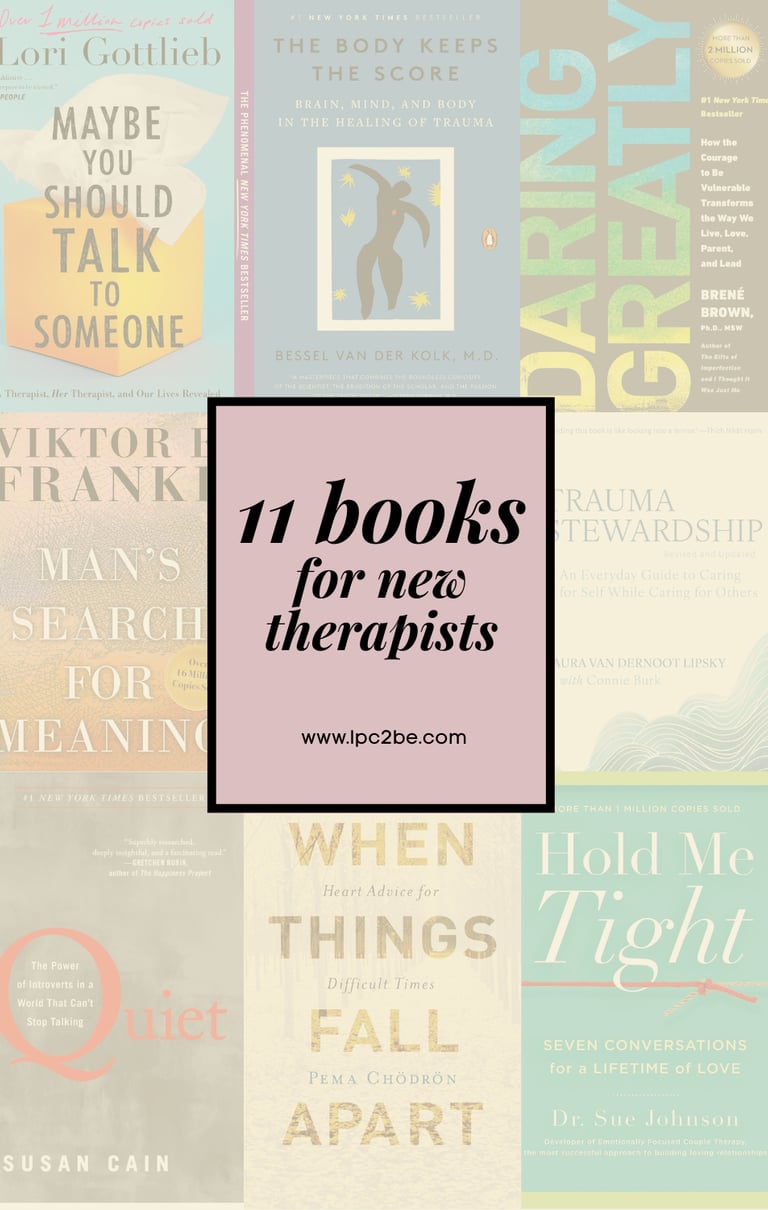
11 Books for New Therapists
11 Books Every Mental Health Grad Student Should Read (That Aren't on the Syllabus)
BOOK RECOMMENDATIONSGRADUATE SCHOOLMENTAL HEALTH
Gina
6/30/20264 min read
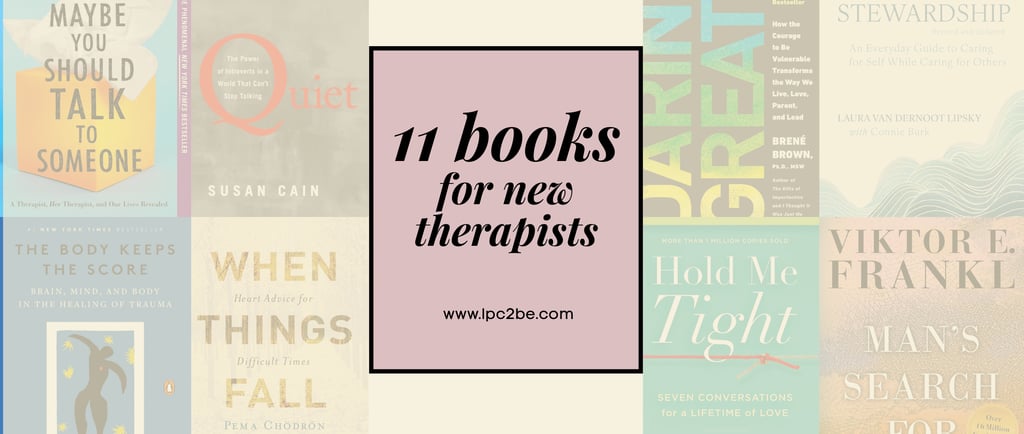
11 Books That Taught Me More Than I Learned in Graduate School
(Sorry, Professors. I still loved your lectures. Mostly.)
Let's be honest: graduate school in mental health counseling is a lot of things. Enlightening. Exhausting. A weird hazing ritual involving APA citations and the phrase "as we discussed in the literature." Somewhere between learning the DSM criteria for generalized anxiety and developing generalized anxiety, I started reading books that weren't assigned — and somehow they taught me more about being a decent, grounded human-slash-future-therapist than three semesters of lecture slides.
Here are 11 of them. Consider this your unofficial, not-on-the-syllabus reading list.
Affiliate Disclaimer: Some of the links in this post are affiliate links, which means if you click through and buy a book, I earn a small commission at no extra cost to you. Given that I am also a graduate student in a mental health counseling program — a career path famous for its emotional rewards and notoriously modest financial ones — every click genuinely helps. I only recommend books I've actually read and would push into your hands at a coffee shop, commission or not. But if you're going to buy them anyway, might as well help a fellow counselor-in-training keep the lights on (and the student loan servicer politely at bay).
1. The Body Keeps the Score by Bessel van der Kolk
Yes, everyone and their cat has recommended this book to you already. There's a reason. It's the book that made trauma click — not as a chapter to memorize, but as something you can practically feel in your own shoulders while reading it. Bonus: you'll never look at a clenched jaw the same way again.
I recently came across a therapist reel on IG bashing the book for being too "heady." Maybe some people may feel that way, but as a psych undergrad and someone with a real interest in how the brain works and the mind-body connection, I couldnt' put it down!
2. Maybe You Should Talk to Someone by Lori Gottlieb
This is the book that reminded me therapists are also extremely, hilariously human. Gottlieb gets her own therapy while seeing her own clients, and somehow this is more instructive than an entire semester of "therapeutic boundaries" lectures. Also it made me cry on a plane, which is a form of professional development, probably.
She also has a workbook to accompany the book now! Find it here: Maybe You Should Talk to Someone: The Workbook: A Toolkit for Editing Your Story and Changing Your Life.
3. Man's Search for Meaning by Viktor Frankl
Technically required reading in approximately 90% of counseling programs, and yet somehow it hits different when you're not annotating it for a quiz. Frankl wrote this after surviving the Holocaust, and it's the book that quietly recalibrates your entire understanding of resilience. Read it slowly. Let it ruin you a little, in a good way.
4. Attached by Amir Levine and Rachel Heller
Attachment theory, but make it readable. This book explained more about why your clients (and, fine, you) pick the same emotionally unavailable partners on repeat than any lecture on Bowlby ever did. Suddenly every relationship in your life makes a horrifying amount of sense.
5. The Gifts of Imperfection by Brené Brown
Grad school will teach you to diagnose shame. This book teaches you to actually sit with it — yours and your future clients'. Brown has a gift for making vulnerability sound less like a liability and more like a superpower you forgot you had.
6. Hold Me Tight by Sue Johnson
If you're heading toward couples work, this is basically the cheat code. Emotionally Focused Therapy explained with warmth instead of jargon, and a level of insight into why couples fight about the dishes (it's never about the dishes) that will make you want to text your partner an apology mid-chapter.
7. When Things Fall Apart by Pema Chödrön
Buddhist wisdom that somehow lands harder than your entire "Theories of Counseling" textbook. Chödrön writes about sitting with discomfort instead of fixing it immediately, which — gentle reminder — is also basically the entire job of a therapist.
8. Quiet by Susan Cain
Not explicitly a counseling book, but it should be required reading anyway. Cain's deep dive into introversion will make you rethink every "client isn't engaging enough" assumption you've ever made. Some people process out loud. Some people process by staring intensely at the carpet. Both are fine.
9. Daring Greatly by Brené Brown (yes, her again — she's just that good)
This one's less about clients and more about you. Specifically, the version of you that's terrified of being "found out" as not a real therapist yet. Spoiler: that feeling has a name, it's incredibly common, and Brown will gently roast you for it in the best way. I felt personally attacked, but also seen and valued.
10. The Gift of Therapy by Irvin Yalom
Yalom writes like a wise, slightly mischievous mentor who's seen it all and still finds the work fascinating. This is the book I wish someone had handed me on day one, instead of a syllabus with 47 required readings and zero emotional preparation.
11. Trauma Stewardship by Laura van Dernoot Lipsky
The book nobody assigns, but everybody needs. It's about protecting yourself while you do this work — which, last I checked, was never covered in a single graduate course, despite being arguably the most important skill of all. Burnout prevention 101, but actually good.
**Update: the revised and updated version is set to release Sept 29, 2026.
Takeaway
Graduate school gives you the scaffolding — theories, ethics codes, the correct way to write a SOAP note at 11pm fueled by stale coffee. But these books? They gave me the texture. The human stuff. The stuff that doesn't show up on an exam but absolutely shows up in the room with a real, complicated, wonderful client.
So if you're deep in your program right now, drowning in readings and feeling like a fraud — add one of these to the pile. Your future clients (and your future self) will thank you.
What books changed how you think about this work? I'd genuinely love to know — my reading list is never actually done.